First-Time Buyers
Why $400K Costs More in Florida Than You Think
 Emmett Dempsey · NMLS #208522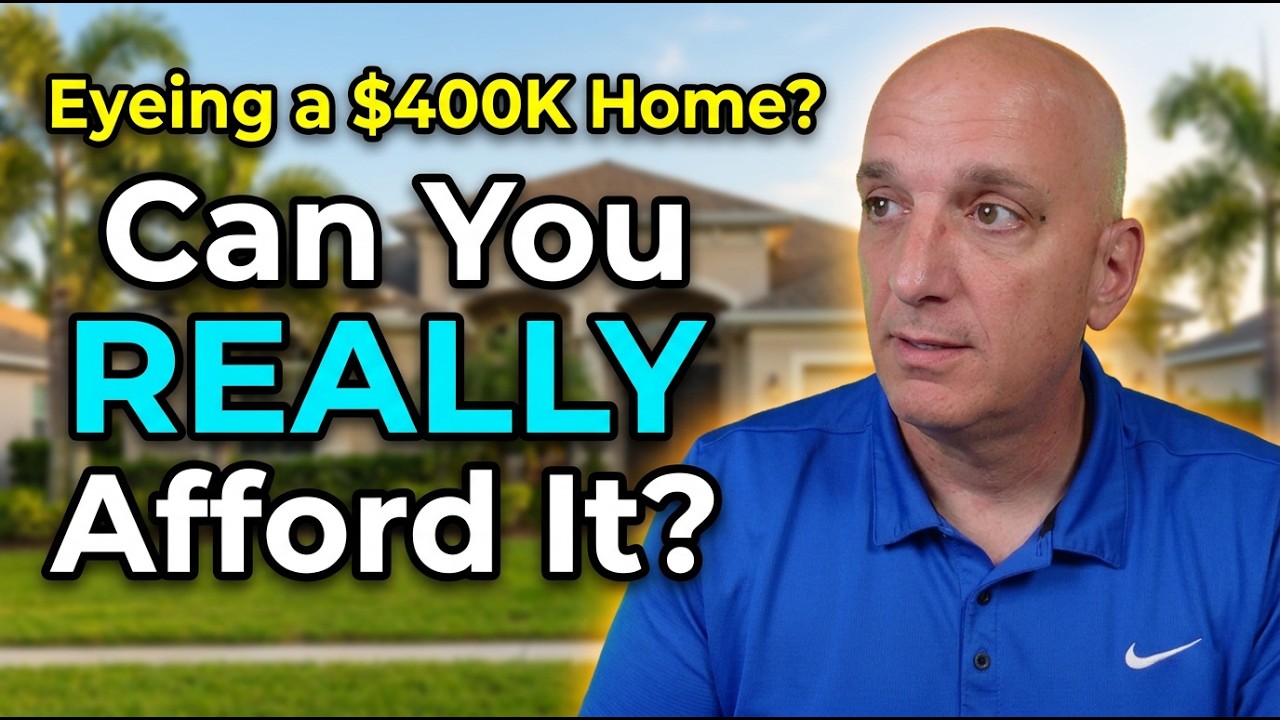
How much house can I afford in Florida on a 100K salary?
On roughly $100,000 a year, or about $8,300 a month before taxes, a lender using a debt-to-income ceiling near 43 percent may allow about $3,600 total for all debts plus your new house payment. Subtract existing debts first. Whether that carries a $400,000 Florida home depends on your down payment, county taxes, and insurance quote. For comfort, keep your full payment under about a third of your gross income.
How much house can I afford in Florida on a 100K salary?
On roughly $100,000 a year, or about $8,300 a month before taxes, a lender using a debt-to-income ceiling near 43 percent may allow about $3,600 for all your debts plus a new house payment combined. Subtract what you already owe first. Whether that carries a $400,000 Florida home depends entirely on your down payment, your county's taxes, and your insurance quote. For real comfort, aim to keep the whole house payment under about a third of your gross monthly income.
That $400,000 price tag on the listing tells you almost nothing about whether you can afford the house. The number in the ad is the one everybody stares at, and it is the one number that does not decide if the house fits your life. What decides it is a payment. And here in Florida that payment has two pieces most buyers forget about until they are already emotionally attached to a place.
Why is the sticker price the wrong number to focus on?
You see the $400,000 and think, do I make enough for a $400,000 house? That is the wrong question. Nobody buys a price. You buy a monthly payment.
Two people can buy the identical $400,000 house. One is in a low-tax county with a newer home and a clean insurance quote. The other is in a higher-tax county with an older roof. Same price. Very different monthly payment. That is why the sticker price is close to useless on its own.
What four things make up your real monthly payment?
Your payment is built from four things stacked together. Lenders call the whole stack PITI. You do not need to memorize the letters. Just remember it is the whole payment, not the skinny number the ads love to show.
Principal and interest. Principal is the chunk of the house you are actually paying off. Interest is what the lender charges to loan you the money. Put a rate on your loan amount over 30 years and that gives you your base payment. This is the part every online calculator shows you.
Property taxes. In Florida your county sets a tax rate on what your home is worth, and you pay it every year. That yearly bill gets chopped into twelve pieces and bolted onto your monthly payment. It sits in an escrow account, which is just the lender holding your tax and insurance money and paying those bills when they come due.
Homeowners insurance. This is the big one in our state. If you have lived in Florida for five minutes, you know where this is going. Insurance here runs higher than most of the country because of hurricanes, wind, and water. Just like the taxes, that premium gets split into twelve and stacked onto your monthly payment. The same $400,000 house that costs someone in another state one number costs you a bigger number, purely because of the insurance line.
Add all four together and that stack is your real monthly payment.
What is debt-to-income ratio and how much income do I need?
Lenders look at your debt-to-income ratio. Do not let the term scare you. It just means, out of the money you make each month before taxes, how much already goes to debts like a car payment, student loans, and credit card minimums.
They add up those debts, add the new house payment on top, and want that whole stack to sit under a certain slice of your income. For many loans that ceiling lands somewhere in the mid-forties as a percent, and some programs stretch higher.
Here is what that means in real numbers. Say you make around $100,000 a year. That is roughly $8,300 a month before taxes. With a ceiling near 43 percent, all your debts and your new house payment together can be somewhere around $3,600 a month. If you already owe about $500 a month on a car and a credit card, that comes off the top. Every dollar of car payment is a dollar you cannot spend on the house. So you are really working with around $3,100 a month for the whole house payment, taxes and insurance included.
Does that carry a $400,000 house in Florida? It depends on your down payment, your county's taxes, and your insurance quote. On a low-insurance, low-tax setup, maybe. On a higher one, that same income might land you more comfortably at a lower price. Same salary, different answer, because Florida's taxes and insurance move the needle that much.
What is the difference between approved and affordable?
There is what a lender will approve you for, and there is what you should actually spend. Those are two different numbers, and they are not close.
A lender's formula does not know about your groceries. It does not know you have a kid in daycare, or that your car has miles on it and a repair is coming, or that you would like to retire someday. The formula sees income and debts, that is it. A lender might happily approve you at the very top of the range. Then real life shows up and the house is eating you alive.
Here is the number I steer people toward. Try to keep just the house payment itself, the whole PITI stack, under about a third of your gross monthly income. Under a third and most people breathe easy. Push toward half and you are technically approved but you feel broke in your own house. That gap between approved and comfortable is the single most important thing on this whole topic.
Do you really need 20 percent down?
No. The idea that you need 20 percent down is not the rule. Conventional loans start at 3 percent down. FHA loans, which are government-backed loans built for regular buyers, go as low as 3.5 percent. And if you or your spouse served, VA loans can be zero down.
If you put down less than 20 percent, you usually pick up mortgage insurance, a small monthly cost that protects the lender and adds to the payment stack. That is the trade-off. But for many people, getting in now beats chasing a 20 percent target that keeps running away while rents climb.
Florida also runs a genuine mountain of down payment assistance. Statewide there is a program aimed at essential workers, teachers, nurses, first responders, and military. There are county and city programs layered on top all over the state. I am not going to throw a specific dollar figure at you, because the amount swings hard by county, income, and program. Just know the help is real, and a lot of it goes unclaimed every year because people assume they do not qualify.
What about closing costs?
One more piece nobody budgets for. Closing costs are the cash you need at the table to actually close, usually somewhere around 2 to 5 percent of the loan. They cover things like the appraisal, title, and setting up that escrow account. On a $400,000 purchase that is real money, and it is separate from your down payment. Some of it can be covered by the seller or built into certain loan programs, but you want to know it is coming so it is not a gut-punch three weeks before closing.
Put it all together
The listing price is just the starting line. Your real number is a monthly payment built from principal, interest, and Florida's taxes and insurance, checked against your income and existing debts, then pulled back to the number you can actually live on. Figure out that number first and you shop with total clarity. You stop falling for houses that were never going to fit, and you stop counting yourself out of ones that would.
The easiest way to see your own number right now is to run it on my free affordability calculator. Plug in your income, your monthly debts, and your down payment, and it shows both numbers side by side, the max a lender might approve and what actually fits comfortably. No name, no email, no credit check, nothing pulled. Just you and the math.
When you want the version built on your actual county, your actual insurance quote, and the assistance you might qualify for, that is where I come in. That first conversation is how we go from guessing to a real payment that fits. You are probably closer than you have been telling yourself.
Frequently asked questions
How much income do I need to afford a $400,000 house in Florida? +
It depends on your down payment, county taxes, and insurance quote, not just the price. On roughly $100,000 a year you may qualify with a lender using a debt-to-income ceiling near 43 percent, which allows about $3,600 a month for all debts plus the house payment combined. Subtract existing debts first. On a low-tax, low-insurance setup a $400,000 home might fit. On a higher one, the same income may point you toward a lower price for comfort.
What does PITI mean? +
PITI stands for principal, interest, taxes, and insurance. It is the full monthly mortgage payment, not just the base principal-and-interest figure most ads and online calculators show. Principal pays down the loan, interest is the lender's charge, property taxes are set by your county, and homeowners insurance protects the home. In Florida the taxes and insurance pieces are larger than in many states, which is why the whole stack matters more than the sticker price.
Why is homeowners insurance so expensive in Florida? +
Florida insurance runs higher than most of the country because of hurricanes, wind, and water risk. Just like property taxes, the yearly premium gets split into twelve monthly pieces and added to your mortgage payment through an escrow account. A home's age and roof condition affect the quote too. This is why two people buying identical $400,000 homes can end up with very different monthly payments depending on their insurance line.
Do I really need 20 percent down to buy a home? +
No. The 20 percent rule is a myth. Conventional loans can start at 3 percent down, FHA loans at 3.5 percent, and VA loans can be zero down for eligible service members and veterans. If you put down less than 20 percent you usually add mortgage insurance, a monthly cost that protects the lender. For many buyers, getting in now beats waiting years to reach 20 percent while rents keep climbing.
What is the difference between what a lender approves and what I can afford? +
A lender's formula only sees your income and debts. It does not know about groceries, daycare, car repairs, or retirement goals. So it may approve you at the very top of your debt-to-income range, which can leave you feeling broke in your own house. A safer target is to keep your full PITI payment under about a third of your gross monthly income. That gap between approved and comfortable is the most important thing to understand.
How much are closing costs on a $400,000 home? +
Closing costs usually run around 2 to 5 percent of the loan amount and are separate from your down payment. They cover items like the appraisal, title work, and setting up your escrow account. Some costs can be covered by the seller or built into certain loan programs. The key is to plan for them early so they are not a surprise a few weeks before closing.
Sources
- What is a debt-to-income ratio? — Consumer Financial Protection Bureau
- What is an escrow or impound account? — Consumer Financial Protection Bureau
- What is private mortgage insurance? — Consumer Financial Protection Bureau
- FHA Loans — U.S. Department of Housing and Urban Development
- VA Home Loans — U.S. Department of Veterans Affairs
About the author
Emmett Dempsey — Mortgage Broker / Owner
NMLS #208522
Emmett Dempsey is the owner and licensed mortgage broker at Treasure Coast Mortgage, LLC (NMLS #208522 | Company NMLS #1958997), serving homeowners and veterans in Florida, Texas, and Georgia. A U.S. Army veteran, he has worked in the mortgage industry since 2007 and specializes in VA loans, reverse mortgages, first-time homebuyer programs, and self-employed/non-QM lending. He has personally used or arranged every product he offers, including a reverse mortgage for his own mother. As an independent broker, Emmett works for his clients, not a bank, shopping multiple lenders to find the right fit for each borrower.
Ready to talk numbers?
Schedule a 15-minute call. We'll walk through your situation and show you what's actually possible — no pressure, no pitch.
Book a call

